
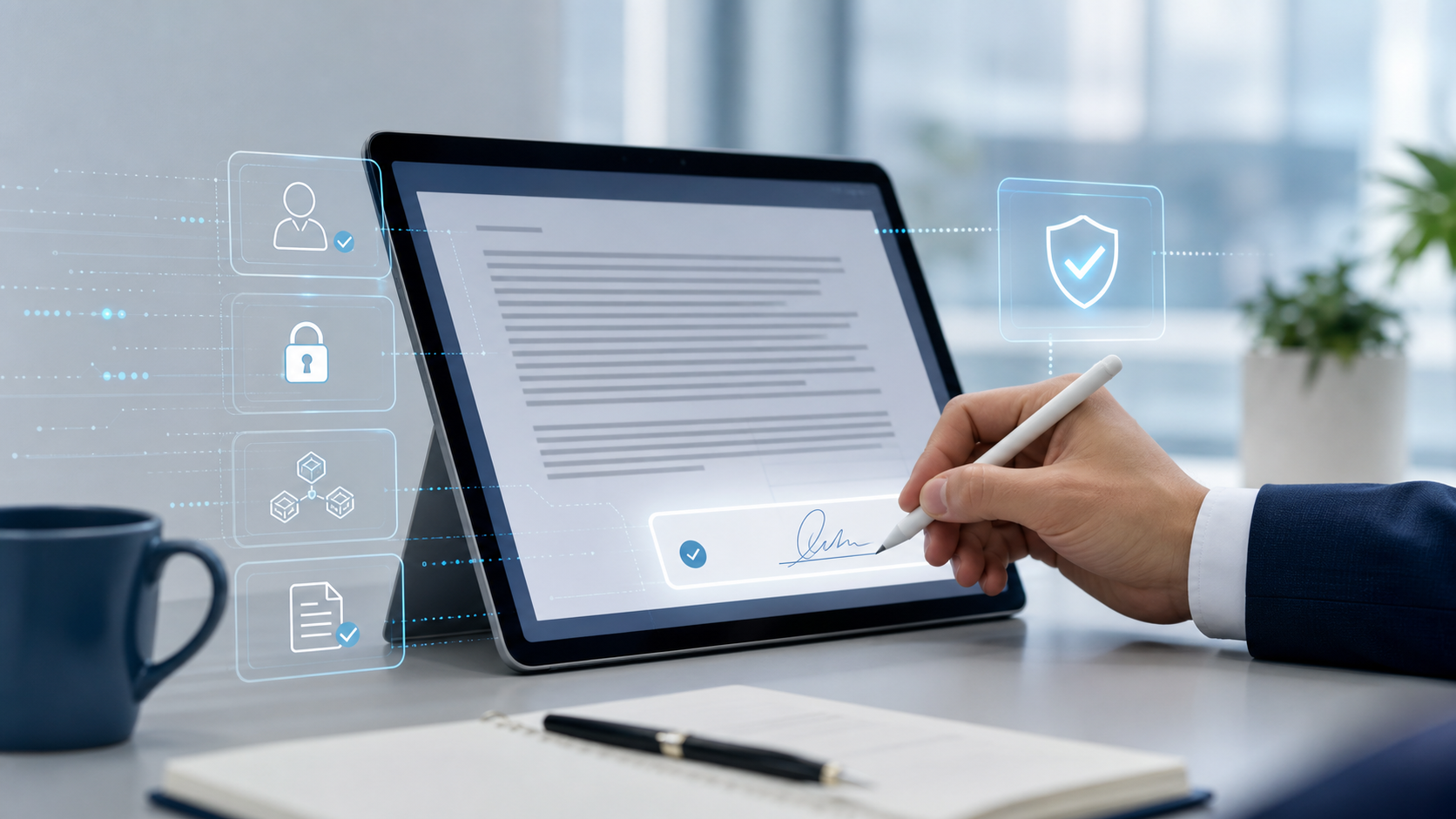
Electronic signature for companies has moved beyond being a competitive advantage and become an operational necessity.
Client contracts, supplier agreements, employment communications, invoices, internal authorisations: every document that flows in or out of a company can be signed digitally with full legal validity.
Here we cover everything a legal, operations or technology manager needs to know to deploy electronic signature with legal certainty and no operational friction — understanding which level each document requires and how to pair it with the certified communications Legalpin provides.
What electronic signature is and why it matters for companies
An electronic signature is any data in electronic form attached to a document that allows the signer to be identified and their intention to accept the content to be verified.
It is not just a digitised handwritten stroke: it encompasses cryptographic credentials, digital certificates, one-time password (OTP) authentication and behavioural biometrics, among other mechanisms.
What makes electronic signatures critical for businesses is their probative value: before a court or public authority, a document electronically signed with the correct requirements carries the same weight as a handwritten signature or, at the qualified level, even greater technical certainty.
The problem of paper in modern business flows
A paper contract requires printing, travel, physical signing, scanning and filing. Each step adds cost, time and the risk of loss or tampering.
Electronic signature removes all those steps: the document is prepared, sent, signed and archived in minutes, with a complete audit trail of who signed, when and from which device.
For companies with distributed teams, international clients or high-volume processes — hundreds of contracts or notifications per month — the difference in operational efficiency is immediate and measurable.
The three levels of electronic signature under eIDAS
eIDAS Regulation (EU 910/2014) distinguishes three levels of electronic signature with different legal guarantees.
Knowing them is essential: choosing a level lower than the act requires can render the document legally invalid; choosing one unnecessarily high adds cost and friction.
Simple electronic signature
The simple signature is the most basic form: it can be as straightforward as a name typed at the bottom of an email, a checkbox ticked on a web form or a PIN entered on a portal.
It does not require robust identity verification or involvement from a trust service provider. Its probative value is limited: it can be challenged relatively easily if the other party denies having issued it.
It is appropriate for low-risk acts where context provides sufficient evidence: acceptance of general terms and conditions, internal surveys, read confirmations on closed platforms.
Advanced electronic signature
The advanced signature meets four conditions defined by eIDAS (Art. 26): it is uniquely linked to the signer, it is capable of identifying them, it is created using data under their sole control and it detects any subsequent alteration of the document.
In practice, it is implemented with digital certificates issued by certification authorities, OTP systems linked to the holder or correctly managed stroke biometrics.
The advanced signature is the standard for most business contracts: non-disclosure agreements, service contracts, purchase orders, HR notifications and commercially significant communications.
Qualified electronic signature
The qualified signature is the highest level. It is generated by a Qualified Trust Service Provider (QTSP) recognised on the EU trust list, using a qualified signature creation device (QSCD).
Its legal effect is equivalent to a handwritten signature across the entire European Union, with no possibility of rejection on purely formal grounds (Art. 25.2 eIDAS). Certain acts before Spanish public authorities, remote notarial procedures and mortgage contracts expressly require or recommend it.
| Level | Identity check | QTSP required | Legal equivalence | Typical company use |
|---|---|---|---|---|
| Simple | Minimal or none | Not required | Limited | T&C acceptance, internal confirmations |
| Advanced | Robust | Not mandatory | High (commercial contracts) | Contracts, HR, purchase orders, NDA |
| Qualified | Maximum (QTSP + QSCD) | Mandatory | Equivalent to handwritten (EU) | Notarial, public authority, critical contracts |
Legal framework: eIDAS and Law 6/2020 in Spain
eIDAS Regulation applies directly in all EU member states and removes barriers to cross-border recognition of electronic signatures.
In Spain, Law 6/2020 of 11 November, on trust services for electronic transactions, complements eIDAS and regulates national qualified providers supervised by the Ministry of Economic Affairs and Digital Transformation.
The probative value in court is reinforced by the Civil Procedure Act and by consolidated doctrine that equates qualified electronically signed documents with public instruments when not challenged.
What happens when an electronic signature is challenged in court
If the other party challenges the authenticity or integrity of an electronically signed document, the burden of proof varies by level.
For a qualified signature, the challenge requires contrary evidence: the presumption of authenticity and integrity operates in favour of the party presenting it. For an advanced signature, the document carries significant probative weight, though technical expert evidence may be required. For a simple signature, the presenting party must supply additional contextual evidence to sustain its validity.
That is why at Legalpin we always link the signature to the complete record: the certified email or buromail that accompanied the signature request, with its time stamp and delivery receipt, forms part of the evidence chain that makes a successful challenge practically impossible.
Use cases by department
Electronic signature is not a tool exclusive to legal departments. Every area of a company manages documents that can be digitised with full legal certainty.
Human Resources
HR is the department that benefits most from digital signing by volume: employment contracts, extensions, condition amendments, sick leave communications, disciplinary sanctions, terminations and non-disclosure agreements all require signatures and, in many cases, certified proof of delivery.
Combining advanced electronic signature with Legalpin’s certified email creates a record that proves not only that the employee signed, but that they received the document at a specific date and time. This is critical for dismissals, sanctions and legally time-sensitive communications.
Legal and Compliance
Legal teams handle high-complexity contracts with multiple parties. The qualified signature is the standard when the act requires it; the advanced signature covers the rest with complete certainty.
Non-disclosure agreements, framework contracts, special powers of attorney and data processing authorisations are the documents most commonly digitalised in these teams. The Legalpin API allows signature, notification and filing to be launched directly from the CRM or legal document management system without duplicating systems.
Finance and Accounting
Certified electronic invoicing is already mandatory for certain cases in Spain, and the trend is towards progressive expansion. Financing contracts, electronic promissory notes, SEPA mandates and debit authorisations all accept advanced signatures with full efficacy before financial institutions.
Legalpin offers certified invoicing that combines time stamping and delivery proof to close the document cycle with the client.
Sales and Commercial Management
Commercial teams need speed: proposals, orders, price agreements, special conditions and contract renewals must be signed without friction. Advanced signature via OTP or personalised secure link is the standard that balances security and conversion.
Legalpin’s electronic signature for companies lets you send the document, obtain the signature and archive the signed record in one integrated flow, with nothing to export or print.
Documents that accept electronic signature and which do not
The general rule is that any document that can be signed by hand can be signed electronically, save for express statutory exceptions.
Documents that accept electronic signature without restriction include: private contracts of all types, purchase orders, invoices, payslips, internal certificates, employment communications, non-disclosure agreements, payment mandates, non-notarised powers of attorney and administrative processing authorisations.
Documents requiring special attention or not accepting electronic signature include: acts requiring a public deed before a notary (registrable real estate sales, wills, certain company incorporations), acts requiring a specific form mandated by law and documents that must be submitted on paper to specific bodies that do not accept the electronic route.
When in doubt, consult your legal adviser: an electronic signature at the wrong level can be as ineffective as no signature at all.
Most common mistakes when deploying electronic signature in companies
Using simple signature for acts requiring advanced. A web acceptance ticket does not prove the signer’s identity robustly enough for a high-value recurring services contract.
Failing to retain the complete record. The signature is just one element: the signed document, the signature certificate, the time stamp, the delivery receipt and the access log together form the record. Losing any piece weakens the evidence.
Modifying the document after stamping. Any change after the stamp invalidates the signature. The correct flow is: prepare the final document → sign → stamp → archive.
Deploying without internal training. Signers must understand what they are signing and how to verify authenticity. A signer who clicks without reading a signature link may later claim they did not act consciously.
Choosing providers without verifying their qualification. Not all providers are QTSPs: checking the EU trust list before contracting is the first step of any serious deployment.
Separating signature from certified notification. Signing without certified proof that the document reached the other party leaves a gap in the evidence chain. Legalpin’s buromail or certified email closes that gap by linking delivery and signature in the same record.
How to integrate electronic signature into business processes
Integration of electronic signature into workflows is the factor that determines whether adoption is real or ends up as an abandoned pilot project.
The most efficient route for most companies involves four steps.
Map the high-volume or high-risk documents. Starting with employment contracts, recurring commercial agreements or HR notifications guarantees fast and visible returns.
Define the required signature level by document type. This decision is made by legal or compliance using clear regulatory criteria: choose advanced for the majority and reserve qualified for acts that expressly require it.
Integrate via API or native connectors. The Legalpin API allows signature, notification and filing flows to be launched from the CRM, ERP or document management platform without duplicating systems.
Train the team and document the internal procedure. A written procedure covering how to sign, how to archive the record and how to retrieve it in case of litigation is as important as the technology itself.
Electronic signature and certified communications: the complete cycle
The electronic signature proves who signed and what they accepted. The certified communication proves that the document reached the recipient at a specific date and time.
When signing without certified delivery, the other party can claim they never received the document to sign, that it was not them who accessed the link or that the document shown to them was not the final version.
The complete flow in Legalpin combines:
- Sending via certified email or buromail with delivery receipt and time stamp.
- Requesting electronic signature on the exact document sent.
- Archiving the record with document hash, time stamp, delivery receipt and signature certificate.
- Optionally, certified SMS as a parallel channel to increase response rates and reinforce traceability.
This record can be presented in any judicial or administrative proceeding without additional expert reports.
Electronic signature by sector: specific considerations
Law firms and legal services
Lawyers representing clients in formal proceedings need electronic signature with certificates recognised by public authorities. Advanced signature covers most client-firm and supplier communications; qualified is required for procedural acts on platforms like LexNET.
Management agencies and property administrators
Management agencies and property administrators handle large volumes of documents for multiple clients. Advanced signature with certified delivery receipt dramatically reduces management time and eliminates document dispersion.
HR departments and companies with distributed workforces
Companies with workers across multiple sites or working remotely need the signing flow to be fully remote. Integrating certified email with advanced signature ensures every employment communication is documented regardless of where the worker is located.
Finance and debt collection departments
Credit and collection teams can send payment demands with the debtor’s recognised signature, strengthening their position in a subsequent order for payment procedure. The debt collection sector is one that achieves the greatest return from the combination of signature plus certified notification.
Deployment checklist for companies
Define the document catalogue that will be signed electronically, with the required level for each type.
Choose a qualified provider or an accredited integrator verified on the EU trust list.
Establish the archiving procedure: what is saved, for how long and how it is retrieved in case of litigation.
Train the signing team on what electronic signature means and how to verify a signed document.
Integrate certified notification as part of the signing flow: do not separate document delivery from its certified receipt.
Audit regularly that provider certificates are still valid and that stored records are intact and retrievable.
Digitise company signatures with legal validity
- Advanced electronic signatures compliant with eIDAS
- Certified delivery and time stamping
- CRM, ERP and document management integration
Frequently asked questions
Does an advanced electronic signature have the same validity as a handwritten signature?
In contracts between private parties, the advanced signature carries full probative efficacy and is very difficult to challenge if the record is complete. It is not automatically equivalent to a handwritten signature in the same terms as the qualified signature, but in practice its value is comparable for the vast majority of commercial and employment acts.
Do all company employees need a personal digital certificate?
Not necessarily. With advanced signature by OTP or personalised link, the employee signs using their verified phone number or email address, without needing to install any certificate. The qualified signature does require the signer to hold their own certificate on a qualified device.
Can a contract with a foreign company be signed using a Spanish electronic signature?
Yes: eIDAS guarantees mutual recognition of qualified electronic signatures issued by QTSPs from any member state across the entire European Union. For counterparties outside the EU, validity depends on the destination country’s legal system; in many cases, a well-documented advanced signature is accepted as contractual evidence.
How much does it cost to deploy electronic signature in a company?
Costs vary depending on document volume, the level of signature required and the degree of technical integration. Legalpin offers plans and pricing tailored to companies of any size, from sole traders to large corporations with a dedicated API.
Can Legalpin integrate with our document management system or CRM?
Yes: the Legalpin API is designed to integrate with the leading CRM, ERP and document management platforms. Legalpin’s technical team supports the integration and provides detailed documentation for each use case.
What happens if the other party refuses to sign electronically?
If the other party refuses to use electronic signature, the alternative channel can be digital burofax (buromail), which certifiably proves the sending and receipt of the document without requiring the recipient’s signature. In many legal contexts, certified notification is sufficient to produce legal effects even without an acceptance signature.
General information only; this does not constitute individualised legal advice.


